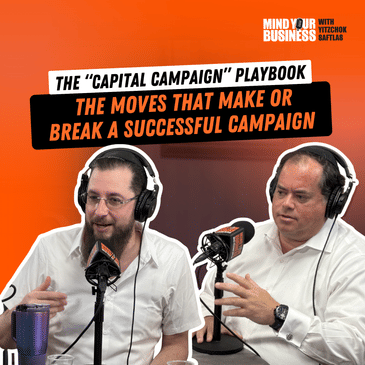
Show (MYB) Altruicity CNSLT.txt
English (US)
00:00:00.000 —
00:00:07.880 · Speaker 1
You can't chart a path for something unless you know where you're going. The very people who are going to support this campaign at the largest level seven figure gifts. They understand what this process is.
00:00:07.920 —
00:00:11.440 · Speaker 2
There's some people that just get stuck. They're like, okay, we can't move forward.
00:00:11.480 —
00:00:20.920 · Speaker 3
There's legal requirements, there's regulations. So if you hesitate or you take your time and then all of a sudden you want to move fast. It can't.
00:00:20.960 —
00:00:24.240 · Speaker 1
We're punishing the kids. Like if it's a school, like guys.
00:00:24.240 —
00:00:27.400 · Speaker 2
By not being in this stunning new building. What are you gonna need, a kid?
00:00:27.440 —
00:00:47.400 · Speaker 1
Exactly. If it's a $2 million project, maybe they'll give $200,000. Answer's no. If it's a $2 million project. But that's a much more attractive project. They might give $300,000. And I said, for the sake of us helping to set the campaign goal, we would like to know if you see yourself either at a seven figure gift level.
Six figure gift level gives us an idea to set a goal, as do you see yourself at a seven figure gift level. And he said yes.
00:00:47.440 —
00:01:55.390 · Speaker 2
Wow. In this episode, I sat down with Yossi Fischler, founder of consult, and Jonah Halper, president of altruist. I asked them straight up questions that can benefit any organization, any yeshiva that's about to embark on any type of campaign, of any size. These are people that are involved in multi-million dollar efforts.
In fact, one of my questions is going to be what? How do you figure out the price point of a campaign? Is it a $5 million campaign, $1,025 million or even greater? What are some of the issues and mindset points that need to be factored in when you're embarking on a major campaign? Who needs to be on your team?
Your board? How do you involve them properly? These incredible guests Yossi Fischler, founder of consult. He directs organizations, had a strategically planned design and execute major building campaign from start to finish. And Jonah Halper, president of altruist, where he works with nonprofit leaders to build thoughtful, sustainable fundraising campaigns.
Without further ado, enjoy the capital campaign playbook.
00:01:59.650 —
00:02:04.530 · Speaker 2
Well, I've been waiting to do this show for quite some time. Welcome to Mind Your Business.
00:02:04.570 —
00:02:05.330 · Speaker 1
Thanks for having us.
00:02:05.330 —
00:02:06.130 · Speaker 3
Thank you.
00:02:06.210 —
00:02:20.410 · Speaker 2
I'm going to turn to Yassi. First, tell us your backstory. Now you're involved in all these big campaigns at. What was it when you were five? When you were 20? Like, what was the aha moment that you got into this and like what's what's the journey like.
00:02:20.410 —
00:04:10.190 · Speaker 3
So you're saying exactly what happened. Since I was a little kid. I always wanted to do design, always wanted to do architecture. Okay. Day one. Went to school for architecture. Oh, nice. You know, finished that and then went to a design build company for nursing homes. Was there for a short period of time, then went to the developer.
And that's where I got a lot of my experience, a lot of my education designing, executing, building skyscrapers, nursing homes, office buildings, little houses over there also, and that I really have a cast of um, to that person. David Marx. It was really, you know, really helpful in getting that deep education.
I managed architectural firm inside, you know, helped with construction company that really gave me the boundaries. So over there I was VP of design and development overseeing all of this. And I saw this niche that was missing that I was taking care of in the company, but I saw was missing in the real world, in the, you know, outside of a developer in all nonprofits or anyone who's a non developer or even a green developer, someone who's not, you know, fluent in all this stuff.
Starting off, I saw that there was a lot missing because owners reps, when everyone talks about owner's reps, they're on the construction side. 99.9% on the construction side and the design side. There's really no one that pulls it all together. So that's where console came from. And it was really sort of a light bulb for people, for myself, that this was really needed.
And we Manage execute design from A to Z from before you have an idea. Programmatic design. Hiring the architects. Interior designers. Critiquing all that design. Dealing with very complicated projects. The mapping streets. Assemblages of properties. Phasing of buildings.
00:04:10.270 —
00:04:11.510 · Speaker 2
Families are founded.
00:04:11.550 —
00:04:33.750 · Speaker 3
It was founded about 12 years ago. So it really it really brought a new era of of responsibility, of design, of execution and truly confidence to all these leaders that they have someone to really lean on through the entire process up until construction. And when you get to construction, it's it's awesome.
00:04:33.870 —
00:04:37.350 · Speaker 2
Amazing. Now we turn to Jonah. First of all, lucky Jonah you live in.
00:04:37.350 —
00:04:39.150 · Speaker 1
I live in Ramat Shamash in Israel.
00:04:39.350 —
00:04:44.830 · Speaker 2
Beit Shemesh. Yes. He's here. It's special. He's here in the States. Tell us about your journey.
00:04:44.870 —
00:04:50.870 · Speaker 1
Wow. Okay. Um, I'll. I'll go way back, okay. Because I grew up in Providence, Rhode Island.
00:04:51.210 —
00:04:52.490 · Speaker 2
And, uh, nice.
00:04:52.530 —
00:08:22.210 · Speaker 1
And when you grow up in a small community and you see how your father and your, your family, your family and other families kind of build community together that you don't you can't just kind of plug in. There's not there's not much there unless you make it into something. Um, I was always inspired, and I and I decided my career should be in community building of some kind.
I wanted to work for the Jewish community. Um, I had no interest in being a pulpit rabbi or in Clay Kodesh like that, but I did feel like I wanted to be involved in, in some kind of organizational development, and I went to school for it. I have my bachelor's in organizational communications. My master's was in public administration, and I just went down that road of saying, okay, like, I want to be involved in helping people who have great ideas and great vision for great, great or, you know, organizations, great, great, you know, projects.
And I want to help them sustain and grow. So I you know, I always said I don't have original ideas of my own. I like to help other people take their brilliant ideas, their vision and make them sustainable and for the long term. And I've built my career around that. I worked in the federation system, the federation in Baltimore, in northern new Jersey for the better part of ten years.
And then in 2010, when I started paying day school tuition and I was like, this whole Jewish nonprofit thing isn't going to cut it. I was like, how do I stay in the space? Because I love it. I love what I was doing. How do I stay in the space but make more of a living? And because of my wife and I, give all the credits to my wife because I am incredibly risk averse, my personality is risk averse.
And she said, you need to go start your own thing. You need to start a consulting firm. And in 2010, so this is 16 years ago now. I started altruistic, which is my my fundraising strategy and project management firm. And in the early days I was thinking it'll be more like a marketing firm, maybe more in like your, your your neck of the woods as far as the work is concerned.
But I really I really quickly realized that my skills that I had built over the first ten years of my career was in bringing in new donors to an organization, building a sustainable base of donors and leadership in an organization, and that that's really where I should be spending my energies. So I started building a firm.
And when you're a kid, when you start building a consulting firm and you're I was turning 30 years old. Now I'm 45 by the time I was 30. And why hire a 30 year old kid when you go hire someone who's got 30 plus years of professional experience? So my angle, my unique selling proposition, had to be, what can I bring to the table that is unique to someone who's young, full of vim and vigor?
Like, what can I bring? Right? And that was the the project management to say we're not just going to be what you would find as typical armchair consultants. We're going to be a firm that's focused on building a strategy, but also coupling it with a strategic, you know, project management to say, how do we execute this to the end?
Because good ideas don't fail because they're not good ideas. They fail because they're not properly implemented. So we're breaking it apart into project tasks, deadlines with professional staffs, doing what lay leadership is doing. And to this day we now have a team of over ten professionals. Um, you know, I am in Israel, as you mentioned, I live in Israel, but most of my, uh, team is us stateside.
Uh, we're in East Coast company, um, and we do annual campaigns, capital campaigns, endowment campaigns. Um, and as the topic of the today being capital campaigns, I right now, like this year, we're doing nine capital campaigns, uh, totaling. I mean, if you aggregate like all the goals, it's like over $200 million.
That's some real impact that we're able to make. So, um, yeah, that's that's a little bit about me.
00:08:22.610 —
00:08:49.480 · Speaker 2
Amazing. Now, the questions we have, we've curated a number of, uh, really great questions that have to do with a yeshiva, an organization, a shul, uh, you know, of, of any size, um, as it relates to major campaigns, um, the questions will sometimes I'll first go to Joan, I'll first go to Yossi. But everyone feel, you know.
Feel free to to chime in because I'm first going to start with Jonah.
00:08:49.520 —
00:08:51.040 · Speaker 1
Oh, man. Trial by fire.
00:08:51.080 —
00:09:13.640 · Speaker 2
I have a fire ready game. Let's talk about this. You know, there are people that look before they leap, that people that leap before they look. Yeah, yeah. Um, talk about if a strategy is not in place, but they they leap right in there. They're ambitious. They want to climb the mountain. They're ready. You don't want to slow them down either.
But at the same time there's, there's there's no
00:09:14.720 —
00:09:17.200 · Speaker 2
trial in place like. All right. How does that work.
00:09:17.240 —
00:11:37.890 · Speaker 1
Right. So so first of all, my personality is someone who just puts their foot on the gas pedal. So I. You know, it's funny because I, of course, I'm going to tell you that strategic planning is integral to the success of any campaign. But that's also kind of counter my imagination. I'm so wired. Let's just do it.
Let's do it. Let's see what happens. Let's go, let's go, let's go. Now that may work. If it's a matter of conquering a fear and saying, okay, let me just like, just not think about it And like public speaking, running and running. But when you're talking about something that's multifaceted and there's a lot of people involved and there's a lot of a lot, a lot at stake, um, you have to have that clarity going in advance.
I mean, the idea of saying, like, we're just going to dive right in and not have clarity, like, well, first of all, start off, what's the vision? Like, where are you headed? Right. You can't you can't chart a path for something unless you know where you're going. So on a very basic level, you have to have clarity.
Like what does that vision look like? What does that kind of full dream look like no matter what you're doing, right? So that has to be in place. And then you can start reverse engineering to say, well, if we want that full dream, what do we need to have in place? Now? I come from the development side. I'm thinking in terms of what do we need in order to raise the most amount of money, where all the stakeholders and the leadership feel involved, engaged, they're engaged and they have a place.
But I'm not on the operational side. I'm not on the building side. So, you know, I have this fantastic tension where I'm like, okay, well, I can give you the structure on the development side, but I can't give you the. I'm not the expert. Like, I know where my arm length is. Like, I know, I know what I can, I can advise on.
But when it comes to a building project, whether it's a shul or a school, I'm not going to be able to tell them, okay, this is how you reverse engineer the full dream on the project side. So usually I will tell them, come to me when you have some level of clarity. And the way I tell them is like if when you have when you're at the level where you can create dedication opportunities.
Because in my mind, if I if they have already synthesized what they're doing on a project, like they have a clarity that full dream and able to reverse engineer to the point where they can basically itemize the things that they have within the space and say, now let's put prices to it, because then I can say, okay, now, now you're giving me a product to work with.
So really that's that's how I think about it is saying, what's the full dream is the first question I always ask, because a lot of times when someone comes to me and says, hey, we need a building campaign. And I ask them, what, how much do you need to raise? And they'll say, we need to raise $20 million. I'm like, great, why $20 million?
00:11:37.930 —
00:11:42.040 · Speaker 2
Right, right, Right. So is that just a number out of the hat or it is. Or there's a plan for that.
00:11:42.080 —
00:12:07.680 · Speaker 1
So usually there's like thinking okay, either it's building purchase or renovations. You know, all the hard costs associated with it. They might be thinking in terms of, you know, you know, maybe operating what it costs to run the campaign soft clauses. But but in the end of the day, um, they're not necessarily including everything.
You don't get to do a capital campaign every year. Like. Right. Right. Like annual campaign is annual by definition. So if you screw it up, right, you can always go next year.
00:12:07.960 —
00:12:54.980 · Speaker 3
But it's interesting that what you said because you want a vision. But how far do you wait for them to go to say how much money it is? Because at a certain point they're going to say, let's say it's 20 million and they designed a little bit, and then you go back to them and say, I don't think you could make 20 million, right?
So then you then you have to start cutting back. So the question is where's that fine line of how much design you have to do, how much thought you have to put in before they go to you and say, okay, this is the general idea. We have some renderings, we have some design. This is what we think it's going to cost. Yeah.
Could we raise this before they go too far? And then they come to you and say, okay, this is going to cost 20 million. And then you go back to them and say you really can only, you know, pull 15 million on this project. You got to go back to the drawing board and it's too far along. So how do you balance that?
00:12:55.020 —
00:13:35.170 · Speaker 1
Okay. So first of all, um, anytime we're doing a capital campaign, the first step we're doing is something called a feasibility study. We don't we our firm doesn't like to call a feasibility study because it sounds like an academic exercise, like a spiral drawing report that you give to them. And it sits on a it collects dust like that's not what it is.
It's a very intentional, uh, process that engages the very people you're going to ultimately solicit. So it's a really great way to engage at an early stage, the people who are going to be carrying a lot of this campaign on their shoulders, in fact, like 75 to 80% of all the dollars raised is, is involved, is is coming from the people that you're involving at this stage, which is a major, major thing.
So what you're saying is like, how do you know if the full dream is even attainable.
00:13:35.210 —
00:13:48.170 · Speaker 3
Until you're not waiting for that donor list. You're that you know in the building, like you're not waiting for all the mezuzah counts and all the door frames and everything to decide what you can raise. You're you're talking about rendering stage schematic drawings.
00:13:48.210 —
00:14:31.810 · Speaker 1
And there's no shame if you if we're doing that process and we're engaging the leadership and we're, we're interviewing the top 25 donors who can carry this campaign. And we get and we see that, you know what, $20 million is not reasonable. It's more like $15 million or $12 million. Then they're able to make smart decisions early before they've already gone too far in.
And and the donors appreciate it. In fact, when they go through this exercise, remember the very people who are going to support this campaign at the largest level, seven figure gifts, like, you know, the million dollar level, the hundred and the hundreds of thousands of dollars, they understand what this process is, is to say, we don't want to just put our foot on the gas pedal.
And wouldn't you be happier to know that we've interviewed all the people who can really carry this campaign and see that, that we need to adjust the campaign goal to.
00:14:31.850 —
00:14:33.090 · Speaker 3
Finish, to finish the project.
00:14:33.280 —
00:15:27.280 · Speaker 1
To do the project. Or even to say we can't have the plan a version, we're going to have to come with a plan B version, and they'll appreciate that. To say you've now made a decision that is not a knee jerk. You know, we didn't you didn't just handicap the project. We're doing the new full dream, which is now the plan B, so that that's really the the goal of it is to engage them early.
So they're, you know, you know, the famous line from Dale Carnegie is people support a world. They help to create. So the idea of going to donors and say, we need to involve you in this stage of the process, and then and then they see what's going on. You're letting them see underneath the hood. I mean, I don't want them to see how the sausage is made in completion.
I sometimes they don't need to know too much, but for them to be involved at this stage is invaluable. And then you don't have cross wires, you don't feel donors, don't feel like they've been bait and switched on on on the on the project. Like, well, I gave you $1 million thinking the project's going to look like this, but now it looks like this.
You've involved them from the beginning.
00:15:27.320 —
00:15:57.900 · Speaker 3
Yeah, this is important synergy. I know it's a cliché word here, but it's important because there are times that people have the donor consultant or the donor idea separate from the design and construction process. They're not synced up and one goes too far or one doesn't go far enough, and then they meet too late.
And then either the donor side has to pull back the donor consultant side, or the design side has to pull back to match up. So meeting up earlier and syncing up is very important.
00:15:58.420 —
00:16:16.460 · Speaker 1
I would imagine even in your world, if if this doesn't happen properly, when you're when you're have to kind of turn it into something that is a case or materials to say this is the project. If they don't have this done, they're probably not going to have clarity. You know, you have to ask them the questions.
I mean, I imagine what's what's your process look like?
00:16:16.460 —
00:16:17.660 · Speaker 3
You'll have a lot of empty slots.
00:16:17.740 —
00:17:18.930 · Speaker 2
No. So it's a fair question. As a, as a as it relates to a capital building campaign. So the marketing approach is, is and that's why even when we spec it out. We quoted out to clients is that there's two separate aspects. One is a proactive campaign, and one is the capital campaign, the relationship fundraising brochure.
And because at the beginning, we're kind of feeling our way, you know, as this, you know, this, it's wet clay for the first six months, for the first year. I usually advise them don't launch a proactive campaign. Only focus on that brochure, because that brochure will give you the tool to then go to your major, major donors to solicit to, you know, present the dream to them, and then you have an idea.
Once that's all clear, then launch to the public. But it's rare that the client is ready to launch a proactive campaign to the public. And that's why I usually tell them focus on that brochure first.
00:17:18.970 —
00:17:28.760 · Speaker 1
Yeah, that's actually consistent with best practices in on our side in capital campaigns, because the process is you do the feasibility study and then you launch a quiet phase of the capital campaign.
00:17:28.800 —
00:17:30.360 · Speaker 2
That's the top relationship.
00:17:30.400 —
00:17:37.280 · Speaker 1
Top seven, six, seven and six figure gift solicitations. And that's going to take a little bit of your time, right. Like, you know, to to coordinate those.
00:17:37.520 —
00:17:38.040 · Speaker 2
612.
00:17:38.040 —
00:17:42.280 · Speaker 1
Months. Yeah. Yeah. We've had the fastest we've ever done was seven months. That's the fastest we've ever had.
00:17:42.320 —
00:17:59.640 · Speaker 3
But it's also important what you're saying that a quiet committee, because in that situation, you could have renderings that are not exactly what the building is going to look like. You could have the drawings that this is a concept, this is ideas. And those people at that level, they understand you're not there yet.
You're still you're still, as you say, molding the clay. Right.
00:17:59.680 —
00:18:36.540 · Speaker 2
Okay. So that we talked just now about fryer fire. Ready. Aim. Let's go to the other side and I'll. I'll turn this to you. THC first there's a concept called paralysis by analysis. Okay. So you want to on one hand, what's your vision? What's your dream? Charted out from the beginning. But at the same time, there's some people that just get stuck there.
Like every, you know, you got to cross the T's and dot the eyes. Okay. I don't have every last one dotted. Okay. We can't move forward. So then you come back a year later. Two years later. Yeah. And the foundation is. It's still a piece of land. Nothing's happening. What is the balance?
00:18:36.780 —
00:19:28.770 · Speaker 3
So it's very interesting. I'm going to answer this. Probably not the way you think. I'm going to answer this already. That's I don't think there's analysis paralysis. I think that there's the people like we just talked about that. Okay. This is this is good enough. Let's start. And then they're tripping their whole way through.
Either they don't have the money lined up. They don't have the the full design team lined up. The design is not correct. They're ever changing with change orders or switching architects or whatever it is on that side that they just jump too fast so they don't have the clarity. The other side is people that don't focus on it.
It's not that they're analyzing it too much and they're like, okay, I have to wait until everything's perfect. I actually find that it's people that don't focus on the product they like start and they're focusing, then they stop, Then two months later, they're focusing again. And then they stop. So they don't.
00:19:28.810 —
00:19:30.170 · Speaker 1
What's making them stop?
00:19:30.850 —
00:19:38.570 · Speaker 3
Uh, they're they're have jobs. They're they're volunteers and they have jobs or even in their job as executive director or other things.
00:19:38.810 —
00:19:42.290 · Speaker 2
But to pick up on Joan is saying it's not because they ran out of cash flow or like.
00:19:42.290 —
00:20:20.810 · Speaker 3
No, I don't think it's cash flow. I think it's a little more focused that that on a project, such a large project, you have to focus continuously because you're going to lose morale, momentum and momentum from from everyone around you. And people are not going to think you're serious. So I think it's it's a little less analysis paralysis, because I don't think I've come across some of that.
I'm not starting until I have everything perfect. Maybe one person I've had that that I want all the money in the bank. I want all the design 100% done. I'm not starting because of so. So usually the pressure to start from the board, from clientele or the pressures.
00:20:20.850 —
00:20:25.590 · Speaker 2
The need, the pressure of the Exactly. It's a school and they and they. I don't have any more seeds.
00:20:25.630 —
00:20:41.710 · Speaker 3
I have a new class coming in next year or two years. I got, you know, I my early childhood has extra class ready by the time gets elementary. I gotta have room for them. So there's pressure to start from that. But the analysis paralysis, it's interesting because you would think that would be the case. I really don't have that.
00:20:41.910 —
00:21:00.750 · Speaker 2
Okay. A client comes with their dream. They want to jump in the the flip side of fire. Ready aim. You know, like what what what is the the potential danger of someone's like just getting to if I may, I was going to hold on to the paralysis by analysis mindset.
00:21:01.190 —
00:21:33.660 · Speaker 1
Yeah. I mean, we we do see aspects of it to, to some degree. Um, I think I think we do see like as we were talking before and more people jumping right in. But I think if, if you give people I think it's a general rule in marketing, if you give people too many options, then they have a hard time making making a decision.
Um, I think that when I start seeing, Things move. Slow down. Or decision making? That's taking too long. It's a very there's a very easy way to short circuit that. To get back on track is you remind them what the big vision here is. You know, like like we're punishing the kids. Like, if it's a school, like, like guys.
00:21:33.660 —
00:21:36.820 · Speaker 2
By not being in this stunning new building. What are you doing in the game?
00:21:36.860 —
00:23:04.770 · Speaker 1
Exactly. Like I know everyone's here. Is busy. We have to reconvene. We have to make some decisions here. You know, these kids need a place or, you know, whatever the program, if it's a synagogue, you know, this place is a dump. You know, you need a tetanus shot just to walk in here like we need. We need something better, guys, come on.
Let's remember, like, sometimes just reminding them that, like, it's easy to get caught up in the details. We're all busy. And as. Yes, he made a good point. A lot of people who are involved in these projects are volunteers. They're lay leaders. They have day jobs. So you're working in evening hours. You're working in times that are not convenient for everybody.
But at the same time, we have to rise to the occasion. And as long as we remind people what the ultimate goal is, again, like, guys, remember, why are we doing this? Why are we doing this? And then they go, okay, okay, okay, Let me. Let me, let me let's just buckle down and make a decision. So that way you're not you're not humoring whatever the analysis is, if you've got them too many options or whatever, what's going on?
It's like, guys, just let's decide something. And I think in general, like, I treat this with my own, my own family, my own kids, like I, you know, I have a child who will say to me, um, you know, I don't know if this is the right decision or that's the right decision. And the other one and I'll say, you make the best decision with information you have, right?
The best you can. Then you've chosen it. That's it, that's it. You're wrong. And then you own it. That's it. And you know that. Now you operate with that. You you the the the the trinity of regret. Coulda shoulda woulda right. Like you don't want. We don't want to be in that world, right? Like you can easily be someone who gets stuck in the mud in that way.
But the answer is you make decisions, you make the best decision with the information you have. And right there you just let's go.
00:23:04.810 —
00:23:31.830 · Speaker 3
I do want to add one thing the difference between Jonah and myself and correct me if I'm wrong. No, no, no. And I approaches that with, uh, a building versus a capital campaign. Any building, even a house. There's legal requirements, there's regulations. So if you hesitate or you take your time and then all of a sudden you want to move fast, it can't.
You have to file stuff. You have to get approvals.
00:23:31.870 —
00:23:32.550 · Speaker 2
Things that you have.
00:23:32.550 —
00:23:52.670 · Speaker 3
To like and not not all of them could run at the same time. Yes, we have ten trains running at the same time usually, but some are linear. And if you wait for this approval to get this approval and then this approval to get that permit, and the early you start, the faster you start, the more attention you paid to it.
It's different versus if someone walks over and says, here's 100 million, you're done, right?
00:23:52.710 —
00:24:09.270 · Speaker 1
And I tell you, I've I've experienced that. We've had clients that have gone on hiatus for like six months or longer because like, oh, we need certain zoning in place and we don't have it. And we're like, okay. So we're sitting there twiddling our thumbs with this. Literally nothing that we could do. We can't give them any advice to help them with this piece of it.
That's squarely and Justice Department.
00:24:09.710 —
00:24:33.180 · Speaker 2
Coming back to the previous discussion, just a little bit about my own background, I went to fight, but the greatest blessing that I had in my career development was I worked for art school for three years. Ramirez, Lawrence. And there's a great line that's attributed to him that really is so apropos here.
He said, what did Ravina say to Rashi? We got to go to print.
00:24:34.660 —
00:25:13.770 · Speaker 2
Now, the reason why that's I. I love using that line again. It's attributed to Edwards et al. Is that at the end of the day, you got to move forward. Art school puts out amazing products, and Ramirez is a perfectionist, a perfectionist. He really demanded perfection. Yet at the same time, a Gomorrah that was on on the timeline of da Vinci had to be produced for the cycle of DaVinci.
That's it. You got to go to print. So now you have the team in place to make sure that it's as perfect as can be, etc. I don't, you know, cross the Tisa I's, but at the same time the trains gotta leave the station.
00:25:13.770 —
00:25:23.210 · Speaker 1
And also, I would imagine even in the case of art school, which is which is so perfect and so meticulous, there are multiple editions because they make changes and fixes along the way.
00:25:23.250 —
00:25:29.290 · Speaker 3
You have to draw a line in the sand and say, we're going. Right. Nothing is ever going to be perfect, perfect. And we can always correct it.
00:25:29.490 —
00:25:39.650 · Speaker 2
Hopefully, when strategic planning for a capital building campaign or a crowdfunding campaign or any type of major fundraising initiative is skipped or rushed,
00:25:40.690 —
00:25:42.050 · Speaker 2
what are the consequences?
00:25:42.090 —
00:25:42.810 · Speaker 1
Oh boy.
00:25:43.530 —
00:25:44.650 · Speaker 3
We could be here all day.
00:25:46.050 —
00:25:47.770 · Speaker 2
Or some examples. Yeah.
00:25:47.810 —
00:26:13.790 · Speaker 1
I mean, here's the thing I skipped or rushed. I sit in the 2000 foot view, so I. I know what the implications are. Most people, when they're doing something in a rushed fashion, let's say rushed, for example. Um, they, they'll come finish the campaign and say we were successful. But what they don't know is how much they left on the table.
Right. And it's just because you were you were able to hit a campaign goal doesn't mean that had you had an extra few months to do things properly. Your campaign might have been, you know.
00:26:13.830 —
00:26:15.630 · Speaker 3
I mean, the goal was too low. Was too.
00:26:15.630 —
00:27:31.580 · Speaker 1
Low. Yeah. I see so many campaigns where, you know, especially like crowdfunding campaigns and things that are are like an anchored fundraising experience that happens each year. And you'd think that if it happens each year, like, maybe we could finally get it where, you know, you start early enough, but invariably there's always bouncing from one one fire to another.
Um, so I can tell you so many examples of when we we finally sat down with a client and said, okay, let's try this a little differently. Let's start doing this three, four months in advance. And we want to incorporate x, y, because we're not going to come in and just give them the same experience that they had, like whatever they did the year before.
Like we're not here to just replicate what they've done. So we want to take it to the next level. We want more time, and we're going to incorporate things that are going to be new, that will bring in more revenue into the organization. And, and hopefully if it's if it's if it's cemented properly, this becomes systems and habits that they're gonna incorporate now moving forward even once we've, you know, exited stage left and every in every one of those cases.
Without fail, anytime that we've been involved, they'll come back and say, like we didn't realize like that it was. There's so much more that could be done, right. Like it's the idea of like, you don't know what you don't know. And and in this case, there's so many great examples of where someone got a gift from somebody that was 100% more than they thought it was going to be, and they would have been fine with the amount that they gave last year because they thought that was the threshold.
00:27:31.700 —
00:28:29.250 · Speaker 3
I want to add to that. I'm living that now before I answer the question directly. We have a client that we're designing a building for, and we're limiting certain parts of it or value engineering it because they feel they could collect a certain amount. And because as experience grows, I'm asking them, so where are you?
Where are you getting that from? Are you tapping this audience? Are you tapping this audience? Why do you think that? Because technically, you're stunting your building design and you're stunting your your permanence because now you're building won't have certain features or will be smaller or you know, for future growth, you're not going to have a room that you want it to have.
So therefore, that's where Jonah comes in to help them expand their horizons and think out of the box of how much money, because it is a a domino effect that if you think you only could get this, then automatically you're going to assume you only could build this. And therefore your programs are limited to this, and it's a domino effect all the way.
00:28:29.250 —
00:28:30.730 · Speaker 2
To establish the low ceiling.
00:28:30.730 —
00:28:31.210 · Speaker 3
Correct.
00:28:31.250 —
00:28:55.690 · Speaker 1
And it's interesting because I think a lot of times people do lower their expectations because they think like, this is all that my donors are going to have the appetite for. And what happens is, you know, you know, if I would come somebody and say, it's $1 million project and I'm going to get from this person $100,000.
So you might say, if it's a $2 million project, maybe they'll give $200,000 and says, no if it's a $2 million project. But that's a much more attractive project. They might give 300,000, 400,000.
00:28:55.730 —
00:28:58.050 · Speaker 2
I've seen that in many campaigns. That's correct.
00:28:58.090 —
00:28:58.770 · Speaker 1
Right there.
00:28:58.810 —
00:29:10.270 · Speaker 2
According to their vision, to their dream, the the the amount that you could secure from a major donor. By accepting them properly is many times more than that.
00:29:10.310 —
00:30:28.780 · Speaker 1
No one wants incremental growth. They want to see something that's transformative, and that is what gets people excited. That's what they salivate over. They're like, I want some of that. Like, how do we do that? Like some of the biggest projects that we know in philanthropy in the last decade, like think about birthright, right.
We're going to send every child, every Jewish child to Israel. That's a crazy vision. Like every kid. Do you know how much it costs to do that? But the the the millionaires and billionaires who got behind that project, they're like, that's something that excites me because that's something that we can sink our teeth into.
And if we could figure out a path on how to facilitate that, that's transformative. So yeah. So if you if we can start thinking especially for our own schools, our own schools and say what does like some crazy, big hairy, audacious goal look like for us in whether it's in wholesale or something specific, what we're doing for a school.
Right. What what would mean another million dollars if we invested in academic excellence, or in meadows or in, you know, if it's if your school that's a more artist soil Zionism school, what does that look like a more immersive experience there. Right. What can you do to make donors more excited about that than to just like, okay, well, we want to pay our teachers, you know, another 10% or we want to offer this.
And you're like, okay, so you need more money because you're making incremental change. Like, like you may get some more money, but it's not going to get people excited. So you have to the bigger vision, right.
00:30:28.820 —
00:30:29.500 · Speaker 2
So to.
00:30:29.540 —
00:30:32.060 · Speaker 3
End yeah I'm going to chime in for for.
00:30:32.220 —
00:30:33.780 · Speaker 2
Specific really relates to your work.
00:30:33.780 —
00:31:37.970 · Speaker 3
Correct. Because for me there's something that we do on into the nth degree is is programmatic and analytical design. So people look at that and it's just a bunch of words. But in reality a lot of people start projects and we've picked up projects like this that they sit down with an architect and or, or, you know, other design professionals and they say, I want this, I want, I want seven classrooms, I need an auditorium, I need, you know, a lunchroom, but it's a one pager at most.
So we go through. We ask thousands of questions, but we don't only ask the top tier people, we don't just ask the executive director or the board members or the principal. We ask. We speak with security. We speak with whoever runs the kitchen. We speak with the maintenance guy. We speak with a handful of teachers.
A big one that we speak to is resource and enrichment, because that is is overlooked how much space they need and how the space is actually laid out, whether throughout the school or one center. So there's different thought processes to that. We speak to the person in the front, the secretary, who's really orchestrating a lot in the building, how parents are.
00:31:37.970 —
00:31:39.490 · Speaker 2
Coming really knows the flow.
00:31:39.490 —
00:33:59.320 · Speaker 3
And students dismissal on arrival. We speak to people that run that, you know, also, we speak to not only the people that are in the building, but who's coming into the building. We speak, you know, whether it's deliveries, whether it is parents, whether it's donors, whether it is, you know, not only everything, where are they coming?
In the front door or the back door? Where? Where are they signing in? The students. Do you want that? When you walk into the lobby, it's quiet. And then the students are are behind security and the craziness of a school, which is awesome. But it's over there. And then also, let's say a parent has to come in because their child is not doing well for whatever reason.
Do you want them to be paraded and everyone see them come in? Or do you want like a nice side door that they go straight to the principal's office? So there's a lot of different things. So we do the programmatic design. It takes, you know, sometimes it takes a few weeks, sometimes it takes a few months. It really depends on the operation, how complex it is.
And then we create spreadsheets of every employee in the organization, including every board member, every last person that is visiting that building. And also we create a room list. One interesting tidbit is that we were doing this for a school, and we were reviewing the resource enrichment. We found out that in one room, it was only used a half hour a day because there was no analysis of who's coming, who's going.
Who's using what. Right arm was not talking to the left arm. It just it really wasn't laid out. If you skip that on a project, you are forever changing the design. Your rooms are too small on the wrong floor. The adjacencies are incorrect. You're missing rooms. You're just going to have unhappy people and a building that is not working for you.
You're trying to, you know, shoehorn into a building. So I would say that is ultimate more than anything, because that one, one tagline that we have, besides that we prevent the coulda, woulda, shoulda, which is what you're talking about before, is we sell confidence. Once you have that and you start designing to your donors, to your board member, to the bank, to everyone you, I'm confident this is what we want and this is what we need, what we modified as we design the project based on dollars, based on fitting on the property, based on zoning, of course, 10% not keep on changing and changing and changing, which will cost you money and time and frustration.
00:33:59.360 —
00:34:47.720 · Speaker 1
So that's and I've seen, I've seen when you have schools that are like a hodgepodge of like additions and expansions where there's none of that intentional work being done. If a school doesn't think that this impacts their admissions and ability to get kids in the school, they're like like, it's incredible.
Because if a parent comes in to check out a school and they see a place that's intentional, whether they even can even vocalize what it is that they love about it or not. Or, you know, they know it's there, and therefore it has real implications on your ability to grow a school in a, in a, in a smart way. Because when you walk into a place that feels like it looks like a hodgepodge, it feels like a hodgepodge, and therefore the person's like, oh, this place is a bygone like I don't, you know, I don't I'm not sure this is the right place for our kids.
Like, there is a end user experience that they're now going to have that will have an implication on your abilities.
00:34:47.760 —
00:35:30.430 · Speaker 3
So some people you can throw out the word feng shui, right? That when you walk into a place and it just flows from next to next. And we're not talking about schools. We're talking about schools, you know. We do a lot of houses as well. So we apply the same philosophy to that. So when any end user, like you're saying, if a, if a student knows where they're supposed to go from end to end because it flows, whether it's the bathroom or the lunchroom or when they first come in or to the playground and in a show, you know, a stranger comes in and goes, where's the show?
Where's, where's the bathroom? Where's the Icer? Where's, how do I get in? How do I get all those things are very important for the end user, like you're saying. And the house also obviously. But but in a commercial setting, it's very important.
00:35:30.950 —
00:35:55.620 · Speaker 2
Are there any stories that come to mind? Are any incidents where like, oh, we forgot to involve someone that cost us a major gift or we or or how could we, uh, kicking ourselves afterwards or the fact that we involved Mr. A or Mrs. B, whatever it is, whatever the case may be, it was like, wow, that resulted in either a, you know, a great gift.
00:35:55.740 —
00:38:59.420 · Speaker 1
So I'll say two things. One is a piece of advice that got early in my career, and then I'll share the story. Um, one of the first things when I worked in the federation system and I started my career at the associated, the Jewish Community Federation of Baltimore in Baltimore, Maryland. And, um, the there was a lay leader who was, I believe, the chair of the women's division.
Like in Federation world like this women's philanthropy that they give separately from their husbands, they give as a woman. So there was a woman there and her name was Linda Hurwitz. Uh, she's now a much more of a high profile on the national scene. Uh, but she gave me the best advice. She said to me, Jonah, you're going to be staffing your first committee.
You're going to be having your first committee. And let me give you a piece of a piece of advice. When you have lay leaders involved in a committee setting, if you give them a good experience, right then, then they take a step forward. It's like furthering their involvement in their engagement. But if you waste their time, right, if it's if they're rubber stamping, if you don't give them anything meaningful to do.
It's just like a feather in the cap for the organization. I go look at our fancy people who are on a committee, right. That's going to take two steps or maybe even more steps back for that person. So it's very important that if you're involving lay leadership, that you do it with, with, you know, gusto and intention and you're doing something meaningful to do, and don't be afraid to do it because you might say, like, oh, you know, they're busy.
They're they're like a millionaire or a billionaire, huh? Ask them to roll up their sleeves. Right. It might be in a formal way or an informal way, but give them something meaningful to do, and they will thank you. They'll say, wow, this was a really. I'm glad I was able to really make a difference if they're just there to, you know, eat the the pan of penny that they're serving you at the board meeting.
Right then then that's not a good use of your time. So that's a piece of advice that I got which I carry through. And anytime there's a leadership involvement I take that really take that very, very seriously. The other thing I would say is, you know, when you talk about before launching and you're going through your all these leadership solicitations and you're having these conversations in advance.
But for the US, I, we had a we have a client in Chicago and it's a school. And they had a tenant that is another institution in there. I don't want to give too much information. I want to give it it all away. Uh, especially, you know, our Jewish community is very small. Everyone knows everybody. Um, so they had a tenant, and this tenant is another nonprofit, and they wanted to solicit for the capital campaign.
The school is going to be doing a capital campaign. Um, a key lay leader of that tenant organization, because they're they're in the space. They know them. And this lay leader is a very, very wealthy nursing home owner. That's not a surprise. The Chicago nursing home owners, and they wanted to go to him for money.
And they were like, they're saying, okay, what's the projection that we're going to ask from for $100,000? That's what we're going to aim for, because some of the people who are more loosely connected at that level is probably going to be at the 100 K level. So I go in to have this interview with him before the project starts, and he's clearly a community leader and someone involved.
And at the end of my questions, I asked them, it's not a solicitation by say, do you see yourself participating in this campaign? Right. Testing the appetite. Right. Right. And he said yes. And I said, for the sake of us helping to set the campaign goal, do we would like to know if you see yourself either at a seven figure gift level.
Six figure gift level gives us an idea to set goal, as do you see yourself at a seven figure gift level. And he said yes.
00:38:59.460 —
00:39:03.420 · Speaker 2
Wow. So you got yourself 900 K, 900 K, and.
00:39:03.420 —
00:39:08.900 · Speaker 1
And how do we not ask that question? The client would have been happy with the 100,000, right? Yeah.
00:39:08.900 —
00:39:09.500 · Speaker 3
We did it. Crazy.
00:39:09.540 —
00:39:17.540 · Speaker 1
We did it. So just ask the question. Do you see yourself giving out a seven figure? If these would have said no, I never said okay, six. And would you be comfortable sharing the range? That's right.
00:39:17.660 —
00:39:18.740 · Speaker 2
It's like half a million.
00:39:18.780 —
00:39:49.760 · Speaker 1
I actually so when that call was over, when I it was a zoom video with him. And when the call was over, I actually went to the script afterwards. I was like, I must have misheard. Like, there's no way. Like, wow. Yeah, yeah. So so amazing. Yeah. So I went to the client and I said, this is why we involve leadership early in often, right?
It's an opportunity to see what what you're dealing with. And that was a wonderful example. And it sometimes it cuts the other way. If sometimes it's like, oh, it's not a seven figure gift. Sometimes it's a five figure gift and You're like, oh my God, I thought this was going to come in way higher. At least now you're able to plan accordingly.
00:39:50.000 —
00:39:51.440 · Speaker 2
Incredibly, you want to tackle this one?
00:39:51.480 —
00:40:04.880 · Speaker 3
Yes. It's very interesting because to have board members in the beginning and lay leaders is very important on a project. First of all, a lot of the board members either are professionals in the field of of real estate and things like that.
00:40:04.880 —
00:40:06.280 · Speaker 2
And they're familiar themselves.
00:40:06.320 —
00:40:33.600 · Speaker 3
Correct. And then in addition, usually if someone is on a board, he's on six other boards. So they have a lot of insight and a lot of just really deep down insight on how to make a project successful. You know, when the cadence of it, you know, to make sure that it keeps moving, the crescendo at the end, that it's, you know, that it's successful.
They don't want to be on a board or on a project of a failing project. Right.
00:40:33.640 —
00:40:34.200 · Speaker 2
That's for sure.
00:40:34.240 —
00:40:34.960 · Speaker 3
You know, especially.
00:40:34.960 —
00:40:35.360 · Speaker 2
You know.
00:40:35.520 —
00:40:43.790 · Speaker 3
With. Right. And the donor, if someone pledges 2 million or 10 million, they want to know that's going to happen. They don't want everyone to know that they pledge 10 million and then the project failed.
00:40:43.830 —
00:40:44.070 · Speaker 2
I don't.
00:40:44.070 —
00:42:31.140 · Speaker 3
Know. Right. So it's very important that it's designed well, executed well. So in the beginning, yes, it's very important to have the board members, executive directors, you know, presence, whoever's involved in there. But and then building committees and everything. But what I've seen is as projects go on, they tend to fall away because they want the people to run it who are supposed to run it.
What I would say is that the communication between the board members and the executive directors has to be consistent, because there are times that board members come back into the picture and are like, what? We're doing this, why are we doing this? So we want to make sure that even though in the beginning we want them, we don't want too many cooks throughout the project, we want to have them in there, have the insight.
Also, sometimes we present every few months, you know, this is where we're up to. Here are the renderings. Here are the drawings. Let me walk you through any comments. So it's it's a concentrated effort, intentional effort to keep them involved. And if they have any comments versus, you know, blowing in and out.
And it's very important to have one person at the helm making all the decisions that whether it's an executive director or if someone's hired just for the project, it's very important that only one person, even if other people are on calls, that's great, but it's one person making a decision. We've you know, we've had some projects where it's not and it's been clarified and everything's worked out, but there were some shaky times where there wasn't one person and therefore things go back and forth and that cost money and that costs time.
And also, if someone is not educated in the design field and they want to make a decision and it costs money, but then they don't know the budget, they don't know the timeline. So it's very important to do that. So there's different times for everything to make sure everyone's happy. And we get to the final, you know, place properly.
00:42:31.180 —
00:43:55.750 · Speaker 1
Yeah. The only other thing I'll give is a piece of advice on managing lay leadership is because a lot of our times the lay leaders are strong personalities, right? So, you know, they they may be experts, but they will let you know that there. That's right. So one of the pieces of advice that I always say is that you never go into a committee meeting without knowing the results of that meeting in advance.
Right. So the way you do that is you have, like, backchannel conversations with the people who are on that committee before you even walk in the room. So I, I want to know what you're thinking. I hear them out because I'm the staff person. I'm the president, I'm the professional. I'm listening to what they have to say.
And I'm I'm then hopefully going to convey what my ideas are. I have an idea where in the wall I want to get to, and I need them to have that buy in, because the last thing you want to do is get in the room. Someone is like a loose cannon on a rolling deck, and then they throw something out there and all of a sudden you're like, whoa, where did my meeting go?
Like, this is now, like, totally a departure from what we need. And it derails everything. And they don't know what they're talking about. And everyone's like, yeah, that's a good idea. Like, you know, the whole thing's falling apart. I need to know before I walk in that room. And it sounds it sounds like it's manipulative.
No, no. Like I know where in the wall I want to get to. How we get there is open for negotiation, but I know that I need to make sure that that there is clarity. As a professional, I know what's best from. From a technical standpoint. So I know where we need to go. But how we do that, I'm not the expert. Like like I'm a GPS system.
I'm recalculating recalculating, recalculating to get to the final destination. But but you have to know before you even walk in the room.
00:43:55.750 —
00:44:38.220 · Speaker 3
So it's good advice. And I would even add that if you're not, if the board members are not in the loop, then they think that the project should have been done a year ago, like where are we? Or the money should have been raised a year ago or or why? So it's very important to have a meeting with whatever party every few months saying, this is where we're at.
This is our projected schedule. This is, you know, different things that they should know. So they're not totally out of the loop. So when they hear something, they're not like, where are we supposed to start six months ago? Or wasn't this supposed to be four floors or now it's three floors or a thousand other things that that come into play.
So I would push for that.
00:44:38.220 —
00:45:55.360 · Speaker 2
I know on this show again, title the Capital Campaign Playbook, we're sharing some secrets. I'll share a secret here from, you know, we're being on the front lines in terms of marketing from here. Bottom line marketing group, um, there are times when, let's say there's a, um, a, a campaign concept that was we worked along with the executive director, director of development and a couple of key people, and then it's being presented to an entire board.
Now, I usually will encourage our key point person at, let's say, the school to make sure it's not a plant, but make sure that you have someone on your board who's got your back, because sometimes you get into that room. I love the way Jonah putting, you know, know what you need to know before you go in so that you could already project the outcome that's so important that sometimes these things can suddenly start roll in a roll off the rail, one person will come and say, I don't like it.
Why, I don't know. I, you know, so have someone, but yet the executive director is going to be in a defensive position. Have someone on the board who's got your back, who's not, is not a stud. He really believes in what was presented. He's he's okay with it. But just in order to steer a conversation in a room with ten, you know, very strong personalities, you know, to make sure that everything moves forward.
00:45:55.560 —
00:46:25.280 · Speaker 1
You just mentioned, like, you know, the fact that we should have their back. It's none of the another very important nuance because sometimes, not sometimes in every case they've hired our firm. And I would imagine it's your case too, is that we are now the person who is like the expert coming from the outside.
Right? Like, we are like we're paying them good money. They're coming in and they're saying, this is how it's supposed to be done. So if the executive director is getting heat, it's there's always the opportunity for that executive director to go. These are the experts. This is what they're telling us, right?
They're giving us the guidance. They're telling us.
00:46:25.280 —
00:46:27.680 · Speaker 2
We hired the professional. And this is what.
00:46:27.720 —
00:47:01.230 · Speaker 1
Right. So there's a there's a, there's a, there's a kind of like a, um, a self-preservation aspect to any executive director who has a board involved saying, like, you know, these are some big decisions we're making, so you're not offloading responsibility, but what you are doing is you're offloading the expertise to somebody who is the expert.
And that does create a dynamic that's actually healthy, where the executive director doesn't become the scapegoat or the the, the bull's eye, for all the ire of of a decision made, if we make a bad decision, it comes on to us. Right, right. So and that's and that's good for the executive director.
00:47:01.270 —
00:47:11.630 · Speaker 3
Right, right. Communication is key. It's just I can't even tell you. It's it's important that everyone's kept in the loop, but on the sidelines, you know, but kept in the loop.
00:47:12.110 —
00:48:05.250 · Speaker 2
We now go to an interesting question. And that is many times for the services that we're providing, there is a donor or a number of donors that see the vision and understand that there's a professional side of it and even pay our fee. They write out the check, as opposed to it coming from the operating of the organization.
This happens in many cases. Question is, what have you seen, let's say, from those major donors, do they appreciate, let's say, the value of what a of what a firm brings to the table in terms of the consulting and building out the vision, even though it comes at a price tag? Or are they like, no, you know, cost is everything and just guys figure it out.
Watch a couple of YouTube videos and and just get going and like, why do we need to pay for consultants?
00:48:05.290 —
00:48:49.160 · Speaker 1
I mean, anyone who's worth any, any board member or a lay leader who is sophisticated at any level, I mean, they run their own business or they're, you know, in any executive position. Well, will say that I will only get behind this project if I see it's professionally done. So if they see that there's that there that you're taking the the measures to do things thoughtfully and strategically, then then they'll say, okay, I'm not throwing my money into a black hole so that.
That without a question I've experienced, I have experienced people the other direction saying no cost at all, at all costs. Um, but those people are tend to be less sophisticated and less understanding and, and hopefully less less influential. You don't want you don't want to be someone who's confident and stupid.
The worst combination is to be confident. Stupid. Right, right.
00:48:51.960 —
00:49:05.560 · Speaker 1
So what? You know, Ida sounds a little crude, but the point is, is like, you know, we want the people to be confident and and sophisticated and understanding and intelligent and therefore say that this is the right thing to do. Um, but but yeah, it's I think it's clear.
00:49:05.560 —
00:49:18.800 · Speaker 2
And of course, I'm going to turn to you see, especially in your case, imagine, you know, a school might say, listen, I have an interior design firm, I have an architect, and I have someone who specializes in permits, like, why do I need consults?
00:49:18.800 —
00:49:21.360 · Speaker 3
So that's a good question.
00:49:22.440 —
00:51:25.600 · Speaker 3
There's a there's a few pieces to that answer, a few parts of that answer. So first of all, it's not only for for donors, even for financial institutions that are lending money. I've been on a lot of bank calls when because they ask a lot of questions and everyone goes, okay, yeah, see where we're up doing that?
What's that square footage of that? What's the cost of that? What's the timeline for that? So the the bank usually has that confidence okay. Someone's watching the pot here. Over here. Someone's understanding what's going on. It's not a free for all. That's so. It's not only donors that feel that way.
It's it's financial institutions. And then also it's parents, right? They know there's someone watching everything. The second part to it is when and this is why I have a part, is that when you have an executive director come in. Right. So you have an architect give drawings, you have interior designer.
Everyone focuses on those main people, right? There are 25 more people involved in a project. Let's say we're doing variances. So there's a real estate attorney, a real estate consultant, traffic consultant, environmental consultant. You go to hearings, then you also have complicated projects.
We've mapped streets. We've put a square block together, many, many properties that we've put together for assemblages. We have buildings that are touching each other, and you have to deal with fire department access. You have it's endless complications. So as an executive director, you you have a job to do, right?
You have to run a school from all aspects. You have your maintenance and your fundraising and your parents and your schedules and everything you have to do. And then an architect gives these drawings and says here. And you're like, I guess it's okay. I don't know how to read drawings, but I mean, you're showing me, you show me what you did.
Maybe I'm a visual. So here's a rendering and it looks all fancy and good. And then same with interior designer, but millwork, low voltage. Uh, Sifre Tura safe. Aren? Kadish. Uh, we master planned sites. So you have hardscape, soft scapes, play spaces.
00:51:25.600 —
00:51:27.720 · Speaker 1
I am overwhelmed just listening to this.
00:51:27.960 —
00:51:33.440 · Speaker 3
Outside outdoor classrooms. Then you throw in low voltage and ave it right and you feel that.
00:51:33.440 —
00:51:36.960 · Speaker 2
People simply don't realize this list.
00:51:37.000 —
00:51:37.840 · Speaker 3
They don't know what.
00:51:38.200 —
00:51:38.240 · Speaker 1
I.
00:51:38.560 —
00:51:59.960 · Speaker 3
Don't know. So I know what what Jonah's experiencing every potential client or even once they're a client of ours first meeting, they're like, what? Like, this is what I have to do to get on a project. And and even on, on, on related to Jonah is that we design with donors in mind. Should be a tagline, right?
00:51:59.960 —
00:52:01.600 · Speaker 1
There you go. Put it on a bumper sticker.
00:52:01.640 —
00:52:33.030 · Speaker 3
Yeah, exactly. So so, for example, we make sure in a lobby that there's no fire strobes or fire extinguishers or water fountains or outlets. Right. We want to put your donor signage. Right, right. It's very important. There are times that people design a building gorgeous, beautiful. And then they just slap on the donor on the wall and like it's over your fancy stone.
It's. It's squeezed in between windows or in a lobby. It's like you have a gorgeous design. And then there's a fire strip, right? Like, buy that letter over there, and then it's right there.
00:52:33.070 —
00:52:37.550 · Speaker 1
I've seen it. I've seen so much. I walk up like I go to the executive. I'm like, that's just temporary, right?
00:52:38.550 —
00:53:40.050 · Speaker 3
So, so, so having having all that. And then another thing that comes into play is that the payments we we've been on projects, we've been pulled in that they got the drawings and like I guess it's okay. And they're like, they got the invoice. I guess it's okay. I'll pay him. And then we come in. He's, you know, you overpaid like he gave you this level.
Whoever, whatever the professional is, and everyone has good intentions. No one's being malicious here. But, you know the architect thing. You said it was okay, so I invoiced you. But then also, maybe they invoiced a little too much. Or the little head of the game because they know they're middle of something else that they're about to submit.
Uh, so sometimes people overpay way before they need it. So having the, the executive director, the donors, the bank, the parents, the board, knowing that someone is watching on the design side and the financial side and the owner's rep side and the programing side brings all this confidence that they did not have before.
00:53:40.770 —
00:53:45.490 · Speaker 1
Geez, I need a nap after that. That was incredible. Yeah.
00:53:45.530 —
00:54:31.760 · Speaker 2
By the way, this ties into something that we touched on earlier in the show, but it's important to just come at it one more time. Yeshiva, an organization. An organization they're about to build and to dive into a major capital campaign. Yeah. The number they come at, it comes at a little bit out of the hat.
$25 million, $10 million. Whatever. It's ambitious. What are some of the steps? I mean, you know, a few minutes ago. Yes, you ran through it, but just really, like, want to come at this that people watching the show because like, well, okay, I'm about to launch a major campaign. I'm so glad that Yossi Fischler, Jonah Halper are sharing.
What are some of the things that they need to be mindful before they come up with that magic number.
00:54:32.160 —
00:54:33.320 · Speaker 1
Before they set the campaign.
00:54:33.360 —
00:54:44.600 · Speaker 2
Before they set the campaign goal? There's no question that you'll see probably them sitting down, drawing out. Remember when yeshiva, let's say yeshiva day school, when they're going into it,
00:54:45.920 —
00:55:16.550 · Speaker 2
right? Ideally, they should build it out to the to the maximum dream that they have in mind, right? The amount of classrooms, the projection, everything. And then, of course, reality sets in because once the campaign launches, you're putting that number to the campaign. You're putting it's an $18 million campaign, it's a $36 million campaign.
And then that's your number you're running with to give guidance to an organization for coming up with that magic number. What would be your input?
00:55:16.590 —
00:55:18.190 · Speaker 3
Okay, I'll take lead on that.
00:55:18.550 —
00:55:20.870 · Speaker 1
I have some thoughts, but. Yeah, but mine's on the. Yeah. Go ahead.
00:55:20.910 —
00:56:04.270 · Speaker 3
So I said programmatic design which gets your programing in. But there is also understanding the cost of a project. So most people think the building they think think the construction. Then I have to hire 1 or 2 design people. It's really not like that. There's a lot of other cold soft costs. There's hard costs and soft costs.
Hard costs are the construction and then there's soft costs. Soft cost is all the architects, the attorneys, the variance, the filing fees. People don't even think about filing fees. There's there's grant fees, right. If you're applying for grants, there's, you know, something that falls into Jonas.
Is the donor signage cost, not the donor where we're placing it or designing the actual cost of the donor signage.
00:56:04.790 —
00:56:07.630 · Speaker 1
Coming out of the operating budget. You need to run your school or your initial right.
00:56:07.670 —
00:57:41.360 · Speaker 3
So people think, okay, I have signage in there and they're thinking building signage, regulation signage, wayfinding signage, but not the donor signage. So if a donor wants a fancy design of the building, they're entitled. Uh, other things are, let's say, and rubber. Kramer. Great. Great person at South Shore.
So one thing he always says, because there's two parts, he always says that that we brought up his half of what a a project should look like from a master planning perspective. I mean, don't think just building or don't think just function. I think the whole thing. So one thing he always mentions is that I'm so happy, not only because I'm happy he's happy himself, but because everyone that pulls up to the school, the landscaping, it's it's it's the finished item, right?
You do this gorgeous building, but the finished item, having that landscaping, especially every season or in New York, but in Florida all the time. But the finished product that you have, the signage correct, you have the function correct. And then you have this gorgeous landscaping that blooms every year with lighting on a night.
So yes, it's a cost, but it brings prestige. Right. So there's a lot that you have to think about. Not when. When a person is doing a capital campaign project, not to think just building. There's soft cost to it. There's also another part that when they think of building, they think the contractor doesn't always put in uh, some items like for and what how that's explained is that if you turn over a building and shake it, everything that falls out.
00:57:41.640 —
00:57:43.840 · Speaker 1
Right, it's, it's.
00:57:43.840 —
00:57:49.440 · Speaker 3
It's explained like that. It doesn't cover everything. But for example, all the furniture number one.
00:57:49.840 —
00:57:51.200 · Speaker 2
When not planning for Sydenham here.
00:57:51.240 —
00:57:51.480 · Speaker 1
Right.
00:57:51.480 —
00:57:52.240 · Speaker 2
Like I'm like.
00:57:52.360 —
00:57:53.560 · Speaker 3
But all the, all the you.
00:57:53.560 —
00:57:54.880 · Speaker 1
Know, it's a good visual though right.
00:57:55.720 —
00:58:42.110 · Speaker 3
And this applies to a show also the same way all the furniture, a lot of people don't have a safe return, safe cost in there. They don't have the process. And the almond, the beam on there. They don't have smart boards, whiteboards, cork boards. They don't have, um, we said donor signage, but they don't have all the low voltage.
That's part of it. They don't have a lot of different items. That is still part of the project and you can't move in without it. So it's very important to to think of the whole project and we break it down for a client. We really break down everything. And it's something interesting, even with the marketing, is when we go to a client and they're starting to think, you know, for donors, for funding campaigns and everything.
And we're building a new building. And I go, look at your old building. You see that logo? It's from 50 years ago.
00:58:42.270 —
00:58:42.590 · Speaker 1
It's, you.
00:58:42.590 —
00:58:43.030 · Speaker 3
Know.
00:58:43.070 —
00:58:43.870 · Speaker 2
It's time for a.
00:58:43.870 —
00:59:07.150 · Speaker 3
Rebrand. Right. So something I tell clients all the time, especially for teachers that, like, hoard too much, like they save every type of project they've ever done or. Or things like that. I say you're doing crazy change now you're building a building. People are moving. They're going to be displaced.
Parents are going to be picking up from their from their kids are now is the time to do all the change. Like really rip it up.
00:59:07.190 —
00:59:07.750 · Speaker 1
Clean house.
00:59:07.770 —
00:59:45.330 · Speaker 3
Clean house. So if you want to change logos, you want to give teachers a different type of storage. You want to change schedules. You want to do everything. They're changing anyways. There's an upheaval anyways. Obviously for the good, there's upheaval. Throw that all in there. Do it now. Right. So I tell clients you're going to bottom line marketing for a marketing world.
You're going to he has to present what you're preparing. So if you're preparing something that has an old logo or old marketing old pictures, it doesn't look good. And then also by the time it comes full circle to me and we want to put logos and donor signage, you want something that is nice, you don't want to put an old logo on a new building.
00:59:45.770 —
01:03:07.200 · Speaker 1
If I could share a story that kind of discusses the the interface between the what the the donor's priorities are and what the project ends up looking like. We have a client that at the really beginning of the engagement, I think even before they even signed on the deadline, they said, well, we have this donor right now, like just, you know, give us some advice right now where it's a woman who came to us.
What? We're doing a new building for a new campus for our school. And? And she would like to dedicate the handicap accessibility. Oh that's interesting. Right? Like, you don't hear that every day. Don't donate the handicapped accessibility. Like, there must be a story there. And he was telling me the the development professional was telling me, you know, that I did my homework and I asked somebody who knew who who knew her.
And she said, oh, you mean Rachel, boss, Miriam, whoever it is. And they said, and by saying that, he realized that, oh, there must have been some health crisis that she was dealing with. And that's why her Hebrew name was just top of mind. And he knew that this was obviously a passion project because something had happened in her life, and handicap accessibility was important to her.
So this, this developed professionals telling me that they were going to get a letter from the rosh yeshiva, um, you know, a nice message about the, the, the, you know, connecting the handicap, accessibility to the, the priorities of the yeshiva, blah, blah, blah, blah, blah. Nice cover letter with the pitch.
And to ask her to dedicate a ramp to go up the middle, uh, you know, to go up, to go up, like, you know, the side of the building. Um, and then I said to him, I said, well, there's one step you didn't do yet. And he said, what is that? I said, well, did you have a meeting with her? And said, hey, you want to dedicate the handicap accessibility?
It's, you know, more of an unconventional ass. I'm curious to know, like, why is this your thing? Ask her, why is this your thing? If she's comfortable sharing, she'll share. If she's not comfortable, she won't share. But let's say I said for the sake of argument. Let's say you ask her why is it that this is the project you're interested in?
And she comes to you and says, when I was a girl, you know, I was a handicapped and I felt like a second class citizen because they would like, you know, they'd like, put me up the ramp through the side of the building. And I didn't feel like all the other girls who went right up the main, the right, the main threshold, right into the building.
So I said, that changes the ask you're going to make in a very meaningful way. If you go to her and just say, we have handicap accessibility, would you support it? You might get some money. But if you say in the narrative that we want every child to feel like they this is their organization, this their school, and not feel like a schlep or on the side of the building, and also.
Where's that? Where's that handicap ramp going? Is it going up the side of the building or is it going right up the middle? Right. Saying this year like every other child. Right. So this is these are very important conversations to have to find out the why, the why of what a donor wants to dedicate. And it's not just a vanity project for everybody.
Sometimes they want the kitchen. We've had uh, I've had a donor, um, for one of our schools that said, I want to dedicate the kitchen. Why the kitchen? My father loved to cook. Okay. And and as you start understanding more about their father and what the father liked to cook, and he was, you know, loved sourdough and love baking sourdough.
You don't think that we were thinking how to incorporate those themes into the into the dedication of a kitchen. Those are very, very important not to keep things superficial, but to understand motivations for donors, what they want to give and they real world implications that it can have on the project doesn't mean like, look, yes, you might come back and say you're a crazy person for wanting to put the ramp right up the middle.
Maybe that's not tenable. And we have to, you know, we have to deal with it. At least the narrative can change about what you're trying to accomplish. But but these are things that. That are real world consequences of having these conversations with donors and what it can mean for a project.
01:03:07.200 —
01:05:12.970 · Speaker 3
So I want to add to to what Jonas said, because he brought up a very valid point regarding we were talking before about people limiting their campaigns because they don't know what they could actually raise. So in design, when we're designing a building, I come across it from a different perspective and along the lines of what you said about sponsoring a Ada access.
So back to Sasha for a second, right? Because it just we spent a lot of time there, and I'm already on my fifth project with Reverend Kramer. So we've been through a lot. Yes, with with more to come. So it's very interesting because back to the landscaping for a second. So it's like, oh, it's a lot of money, I don't know.
But then there was one person that saw it and was like, I loved it. And they and he sponsored it. And then there was a side strip by their building and I wanted to do a playground, lower level playground, meaning age wise. And we did Winding Rubber Road and we did, you know, certain types of items, not complicated.
And it's like, I don't know, it's a lot of money. How am I going to get it sponsored? And then someone sponsored it, and it had to do with October 7th and everything. It was the whole thing. And and the person sponsored. So one thing that that Jonah sells and I sell from a different perspective is if you limit your design because either you're suckers for what you could raise are low, or you limit your design because you don't think that you could actually get it donated.
Right? Who thought an Ada ramp could be donated? I always push one. So we prepare a donor sheet for Jonah for, you know, type or the client that we we prepared. Just like we design, we split buildings for different wings and we create headers for donors. We in design. So we're designing for the donor as well, not for only the function.
We also prepare a spreadsheet of all those opportunities. And sometimes we get feedback like you put that on there. No one's ever going to donate that. And I'm like, wait and see. If someone doesn't donate. It's something that we could pull out.
01:05:13.290 —
01:05:34.010 · Speaker 1
Okay? And they can come to me and I can show them comps of what is typically donated. As we have that we have that 20,000 foot view to say, this can be or we've never seen it, but like, like you said, like, let's give it a shot. Why can't. You can you can have stuff that doesn't sell in a capital campaign. Correct.
If something can go for years, that kitchen that I mentioned before that was dedicated by someone because their father that happened like 3 or 4 years after the.
01:05:34.050 —
01:05:36.850 · Speaker 3
Day and they had to put the kitchen in anyways because they needed a kitchen.
01:05:36.850 —
01:05:42.330 · Speaker 1
In the kitchen. But it was like something that was a specific thing that they wanted. And it doesn't have to go right in prime time. It can go wherever it is, right?
01:05:42.370 —
01:06:23.800 · Speaker 3
So I always tell people, let's design, you know, obviously design with a budget we have everyone has constraints and everything, but don't hold back on something that could be amazing just because you think at this point you won't get a donor? If you do get a donor? Then yes, well, execute on it. If it's easy to pull out certain things, just talk to people differently.
I'm like that also. I rather said of giving $1 million, I'd rather sponsor a specific thing because it just it feels better. I mean, I'm not the one to have a name on a building. It's not my thing, but I understand it and respect it. But but specific items are are very important not to to Pooh Pooh it and say, oh, whatever, we're not going to put it on the list.
01:06:23.840 —
01:07:21.940 · Speaker 1
Yeah. Literally one week ago we had we have we have a client right now that's doing a campus and they he met and the executive director mentioned to me almost offhanded, saying, you know, we're going to make this outside really nice. I was like, so I'm like, obviously my antennas go up. I'm like, well, what what are you doing to the dedication?
He said, well, it's like the, the, the yard, the out, the courtyard is like a real great place for our boys. And to be able to be there and have a good time. And we have a donor that he was telling me just like minutes before who was notorious. That's where it's notorious. Is like a negative thing, but was famous for having community people in their yard all the time.
Like their yard. Like their house was like the place where all the kids came to play. And it was. And they were moving out of the community. And it was like the last opportunity to come to them out of a car, like, oh, if their kids went to the school, you know, would you support this thing? And I said to them, why don't you go to them?
And for the sake of the story, I'll change the name and say, we want to dedicate this yard and call it The Goldbergs backyard right at the school. Right.
01:07:22.260 —
01:07:22.980 · Speaker 3
It's awesome.
01:07:23.020 —
01:07:42.140 · Speaker 1
Right. And they went. They made the ask. It was a $250,000 pledge. It's amazing because they said something that was relevant to them. It was a legacy piece for them because they were moving out of the community and their yard was the back yard. And now it's called the backyard at the school. It's the Goldbergs backyard at the school.
And in perpetuity.
01:07:42.180 —
01:07:52.210 · Speaker 3
I'm going to bring up two other projects of the same thing that came up recently. Totally out of left field cemeteries Still, still.
01:07:52.210 —
01:07:54.410 · Speaker 1
I've never done one, so you know. This is all you.
01:07:54.410 —
01:08:01.410 · Speaker 3
So? So it's still a nonprofit. It's an organization, actually. They do a lot of rest. And there's a lot of they don't charge people.
01:08:01.730 —
01:08:03.730 · Speaker 1
The end user doesn't complain though. That's it. That's it.
01:08:04.850 —
01:09:10.240 · Speaker 3
So so we've been talking to them about about they want to renovate the building that they're, that they have. And and I noticed I was like there's no donor signage anything here. There's no I mean maybe they solicit and they get I'm sure they do. But it's like there's no presentation that when people come.
I said, it's such an honorable thing. Whether you're helping out, let's say you want to sponsor for the person that does the service. Right. There's so many opportunities there. And I was very surprised that they didn't take the opportunity. It's not only to solicit people. People want to give. They want they want to to help out, be involved.
And I was very surprised. And maybe, maybe we'll do it together. Very surprised. Um, that and not only that, a week later a different cemetery called me. Just no connection whatsoever. It was just very odd that they came up. But you never know what type of project is, and you just shouldn't limit what you think you could get or or cut out because you just never know what.
Someone has a passion, they have a backstory. And therefore I'll elevate your design.
01:09:10.720 —
01:09:17.960 · Speaker 2
You know the expression, right? Time flies when you're having fun. Yes, we are basically at a time, but we're going to get in another three minutes.
01:09:20.200 —
01:09:30.200 · Speaker 2
Maybe each of you could share. Now, first of all, by the way, Jonah just came out with a new release. We want to hear a little bit about your new book. And yes, if you could just share as you as we approach.
01:09:30.400 —
01:09:31.880 · Speaker 3
I'm coming out with the book soon.
01:09:31.920 —
01:09:32.359 · Speaker 1
Okay.
01:09:32.440 —
01:09:33.000 · Speaker 2
Yours.
01:09:33.160 —
01:09:35.640 · Speaker 3
No, I didn't start yet, but.
01:09:35.720 —
01:09:36.120 · Speaker 2
It's gonna.
01:09:36.120 —
01:09:37.200 · Speaker 3
Happen. I got a computer.
01:09:37.319 —
01:10:16.660 · Speaker 2
It's gonna happen. But as we approached and of course, this incredible show, The Capital Campaign Playbook with Yossi Fischler, founder of consult, and Jonah Halper, president of altruist. tricity. Again, thank you so much for schlepping out from wherever you are from from your locations. Of course, for Mary, Doswell is a bigger trip than the Five Towns, but it's nonetheless everyone you know that came at in order to share this incredible content with organizations of any size.
And this. We shared so much information. But perhaps a tip, something you could share? It could be from the new from the new book. We'd love to hear about it, the name of it, and you'll see some takeaway as we close out the show. First I'm going to jump.
01:10:16.700 —
01:10:21.620 · Speaker 1
All right. So yes, I have a new book coming out in in. Well, I don't know when the podcast is.
01:10:21.660 —
01:10:22.900 · Speaker 2
I'm saying it's going to be out.
01:10:22.940 —
01:11:07.609 · Speaker 1
It's almost out. It's almost out. The book is called Magnetic Mission, so it's got some good alliteration to it. Um, the the premise of the book is that we are very conditioned to experience fundraising as something like, you're chasing your donors, right? Like, I need this as a fundraiser. I need your money in order to accomplish my mission.
And that desperation comes through in every interaction that you have with your donors. And it's actually not the way, if you look outside of the especially the our from or religious world, it's not how fundraising is done. If you were to go to a university setting or a hospital setting, there's none of this desperation of running around saying, can you give to my campaign?
And we have 10,000 things that we are giving to every year. I mean, we have we have like our religion is built in with Meister and Kim
01:11:08.770 —
01:14:28.210 · Speaker 1
Slonim 18,000 crowdfunding campaign. So there's no shortage of stuff coming through. But the way fundraising needs to be done is more of a function of looking for the alignment. And what do I mean by that? And it's the idea of a magnetized pole, like let's say you have the North Pole and we're magnetized towards that.
So I know if I'm a school that I have certain priorities, I care about academic excellence. I know it could be on a on a Torah level. It could be on general studies level. I know that, you know, like using the example from the school I mentioned before, love evaluates astrology. That's a priority. And the third one might be Meadows character development.
So if I know those are my priorities, and I go meet with somebody who sits right next to me, and Sean's worth $1 billion, and they're interested in saving the whales, right? Probably not the best prospect, right? Even though they sit next to me in shul. Right. However, if I know there's somebody in the community who I don't know yet doesn't know my school yet, but they're a big supporter of Magen David Adom and the IDF.
And I go to them and say, hey, I would love to hear about your giving, what you why you give to what you give to. I know you give to a lot of Israel classes. We are a school that Israel is a very big piece of who we are, and I'd love to learn about your giving now it's relevant and as I listen and first of all, what's the major dynamic shift right here is that instead of me as a fundraiser, going in and vomiting up every single program and service that I have to offer, we do this, we do this, we do this, we do this, we do this, this.
And then at the end, hopefully something's stuck. And then I'll say, would you give to our our campaign? I'm listening. 80% of my conversation is them talking and sharing what they love, why they give this all. I'm always asking why, why, why is that your thing? Why do you hear about that? And when I understand that, then I can follow up with them.
I go back to my office instead of going, what should I do with this guy? How do I what's my next up? No no no no no. Now I like he told me plenty of information. I could say, hey, you know what? We have a yeoman's parade coming up. Or we might say to them, uh, you know, we, uh, take a look at this. What's that video I just sending you, um, the the the first grade is doing a gym class with a giant floor map of Israel, and the kids have to run from Haifa to Bavaria.
It's a tough area to a lot. And so it's like a gym thing. And what you're showing is you're not just paying lip service. The idea that, oh, we love Israel, look, it rolls up all the touch points. I'm giving you a roll up to the mission of what we're doing. So instead of just going giving someone a cheesecake for us or going out for them for coffee, which might be general engagement, it just develops a stronger connection with you as a person.
You're giving them things that are rolling up to the things that they care about. You're scratching the donor's itch. You're not. It's not. I need this. You're removing this rich and saying I'm giving you the thing that you want and the thing that you love. So the book that I'm coming out operates under that premise.
And therefore, like the stories that we've been sharing today on the, on this podcast about like, for example, saying, I know that you love having children in your backyard and that all your friends, all the things that you love is from that experience. And we want to make that in perpetuity and give a place for the kids to have that forever.
You're, you're you're addressing what they care about and what they love and making about what what what about them if you do anything. Otherwise, if it's all about what you you're treating your donor like an ATM machine. You're going to them for a withdrawal, right? And you say, thank you very much for your gift, and you come back to them one year later.
If it's annual campaign and, you know, whatever the case may be, but you're not setting yourself up for long term relationships and success.
01:14:28.570 —
01:14:29.530 · Speaker 2
Amazing. You'll see.
01:14:29.570 —
01:17:07.690 · Speaker 3
Okay, so the first thing I want to say is that I deal with a lot of board members, executive directors, presidents, all different types of people in the nonprofit world. Not for profit world, either. One. It's very important that I give a shout out to them and truly thank them, because they put so much effort and so much time into these projects, and I see it firsthand.
It's and they don't get paid and it's day and night. And whether they put their money in it or not separate discussion, but they work hard. And there are times that there's contentious, you know, like it doesn't work. Well, I miss something. They miss something. You know, you're right. Bumps in the road.
Exactly. But end of the day, we all want the the end result. I have kids in school. I want my school to be great. I go to shul. I want my soul to be great. Like, you know, things like that. It's very important to to recognize all the effort that they put in to make things happen. Now, on the other flip side is that I've been president of Base Field of Inwood for the last three years, and I've also been a board member of Inwood Mikvah in the Five Towns, The Shoals and the Five Towns also.
And I helped with construction. But also I've seen I've seen their side. I've seen their side. I've gotten the complaints I've gotten. Why are we doing this? Why are we not doing this? I've had to answer to a lot of people. I understand their side. That's a little different than we have. And my shul is very large.
We have an event space. We have over 200 member families. We have a million things flying all the time. It's it's Grand Central. So therefore, it's not only that we're looking at it from a design perspective, that we're coming in as a design person and helping you out. We're living your life also. As a president, I have board members that I have to answer to.
I have a love that I have to speak to. I have members that I have to get back to. There's timelines. Yes. No one could do everything. They're sequencing. You need money. You need. You know, a shoal has a little less pressure than a school to move things along because people fit. So if someone might have to switch seats here and there, it's not like you don't have room for a class, right, or no room for resource enrichment or other stuff.
So it's a little different. But we're we're living it. Right? So we bring that expertise to have both sides and make sure a project is thought through from their perspective, from the front function perspective, the money perspective, the design perspective, and really pull together to get the end result that there's no coulda, woulda should've.
01:17:07.970 —
01:17:08.730 · Speaker 1
Love it.
01:17:09.090 —
01:17:30.890 · Speaker 2
What an amazing show. The capital campaign playbook. We certainly hope that this helps your shul, your organization, your capital campaign, and a major way, of course. Feel free to leave comments in the comment section below. Special thank you to Yossi Fischler consult Jonah Halper of Altruist City.
By the way, how can people find out more information about consulting?
01:17:30.930 —
01:17:47.830 · Speaker 3
So first of all, thank you for pronouncing correctly. It's consult, not consult. But I get both. And technically we do both. But it's it's consult without the vowel. So it's slt grp com. So it's group without the vowels and consult without the vowels.
01:17:47.870 —
01:17:49.310 · Speaker 2
And Jonah your website.
01:17:49.310 —
01:17:50.870 · Speaker 1
I have lots of vowels of mine.
01:17:52.910 —
01:17:53.830 · Speaker 2
I'll twist it.
01:17:53.870 —
01:18:05.430 · Speaker 1
Altruistic. So it's kind of kind of the combination of altruism and city. So it's alt r ui city comm. And that's where you can find us. Everything's there.
01:18:05.550 —
01:18:11.990 · Speaker 2
And of course we wish everyone great hearts and all their big vision picture projects.
01:18:11.990 —
01:18:13.590 · Speaker 3
Thank you for having us. Thanks for having.
01:18:13.590 —
01:18:25.710 · Speaker 2
Us. Very special. Thank you for joining me on this edition of Mind Your Business. Please subscribe to the channel so you'll automatically be informed when the next episode goes live. See you in the next episode.