
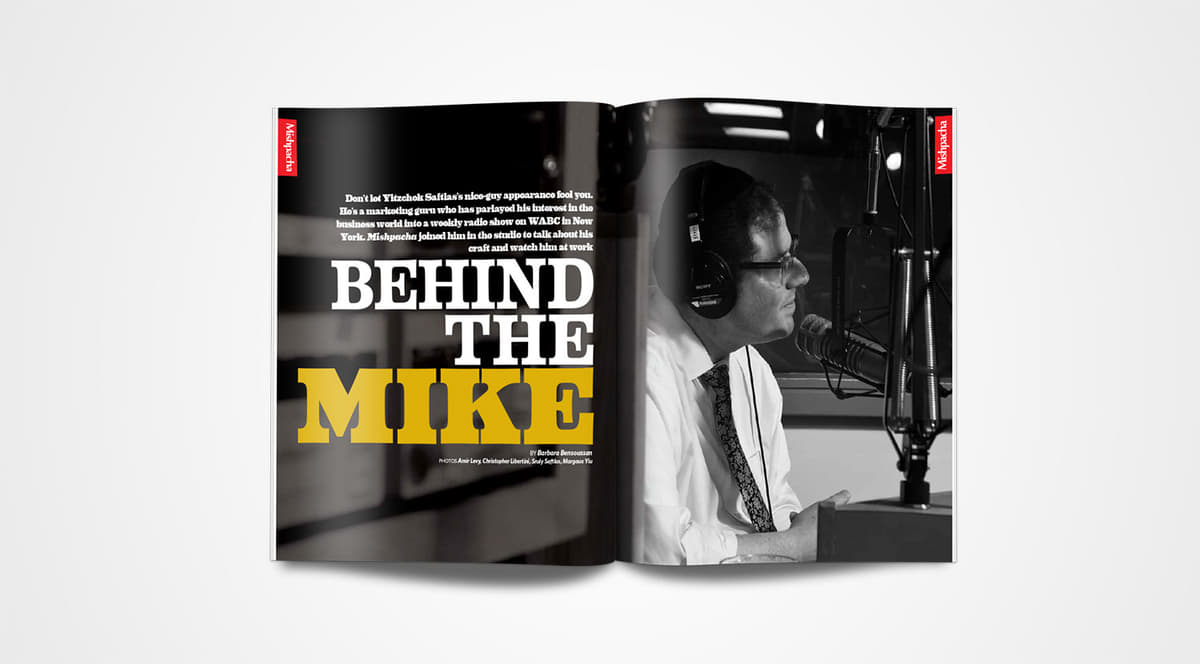
Yitzchok Saftlas, Flatbush resident and the founder of Bottom Line Marketing, recently got a call from his brother-in-law, who said he'd been collared in shul: "Hey!" said the man accosting him. "I saw that your brother-in-law Yitzchok has a show on the radio - but he looks like a regular frum guy!"
A "regular frum guy" on secular radio. An oxymoron? Not in Saftlas’s case. The 46-year-old former talmid of Adelphia Yeshiva and Zichron Eliezer has become the host of a business radio show on WABC, one of the most popular talk radio stations on the air. “I never realized how many frum people listen to the radio till I started my show,” he says.
With his wholesome yeshivish appearance and soft, eager-to-please manner, Yitzchok does seem the quintessential frum boy next door. But don’t let the eidel personality trick you into underestimating his talent and passion for business. While still in beis medrash, Yitzchok attended a top marketing program (“I went with another frum guy,” he qualifies), and envisioned a career on Madison Avenue. Then Rabbi Paysach Krohn helped land him a job at ArtScroll, where he stayed for several years before founding his own company, Bottom Line Marketing, in 1992. Yitzchok also pens a Yated Ne’eman column, and in 2015 published a book about marketing titled So, What's the Bottom Line?
The WABC radio station operates out of the expansive 17th floor of 2 Penn Plaza, the building fronting Madison Square Garden in Manhattan. Well known radio personalities like Rush Limbaugh and John Batchelor have held forth from this labyrinth of clean but utilitarian offices and recording studios. Yitzchok was signed on to create a business-focused show entitled Mind Your Business, airing every Saturday night at 11 p.m. Each week, Saftlas interviews a different leading light in the business world, eliciting their insights on how to achieve and maintain success.
While the show airs on Sunday evenings, he records it on a previous weekday. “Some people choose to do call-in shows, but I prefer to pre-record,” he says. “It’s too much of a challenge to my guests to come in at 11 p.m.”
He reminds us that pre-recording is the norm in much of radio and television. “Remember the Megyn Kelly–Donald Trump interview that caused such a sensation? That interview was being talked about a few days before it actually aired.” With only an hour — actually closer to 50 minutes, with time for commercial breaks and top-of- the-hour news — to dedicate to his guests, pre-recording allows Yitzchok greater artistic control.
“Some shows are call-in, but my con- cern is that I wouldn’t garner the kinds of sophisticated questions I’d like,” he says. “My show educates people about business and marketing, so I prefer to curate the questions myself in advance.”
Air Time Yitzchok isn’t a newbie to the radio business; for about four years, he regularly sat in for Nachum Segal – whom he still considers a friend and mentor — when the latter did live radio on 620 AM. “About ten or fifteen times a year I’d do the show,” he says. “Of course the content was differ- ent — it was a music show. But I was able to bring those radio skills with me when I began at WABC.”
Yitzchok relates that the opportunity to do the show really came about through Hashgachah pratis. “I had helped someone out in business, not for any personal gain, and a few months later he heard of an opening at WABC,” he says. “He reached out to me and asked if I’d be interested, and I immediately said yes. He told me to prepare a plan and a pitch for a weekly show, and they agreed to give it a try.”
Despite the late hour, the station estimates that anywhere between 15,000 and 50,000 people tune in to his broadcast every Sunday, from a listening area that extends from Boston to Baltimore to Pittsburgh on a clear night. “The station gets Nielsen ratings, but it’s not an exact science,” Yitzchok says.
Saftlas made news on his show last sum- mer when “Miracle on the Hudson” pilot Chesley “Sully” Sullenberger criticized New York governor Andrew Cuomo’s up- grade plans for La Guardia Airport, which don’t include lengthening runways that have been called too short.
“I’m sure it would be difficult and expensive,” Sullenberger told Saftlas, “but there have been more difficult challenges taken up around the world. It’s a sad commentary that many of the most advanced airports are outside the United States.”
Yitzchok uses his Jewish name — not the English Ira or the more manageable Yitz — but it’s not always easy being the only per- son on the floor wearing a yarmulke, visible tzitzis, and the one who doesn’t shake the female hands so automatically proffered. “It can be uncomfortable at times, but I’m not going to compromise or change who I am,” Yitzchok says. “I want to show the world that a frum Jew doesn’t need to change who he is to do a great job with a radio show.”
The occasional sh’eilah does come up. For example, Yitzchok had to ask about what to do with the program when it conflicts with Yom Tov — as it did this year, when it aired on Shavuos. “Even though I pre-record, my rav told me to get a non-Jewish guest host to sit in for me on those occasions,” he says.
Staying Centered Saftlas prepares meticulously for each interview with the help of his team. Pesach Tropper serves as producer, reaching out to celebrities to book them for shows. Yitzchok also meets with team member Meira Beitler to discuss possible talking points for each guest, after which she prepares questions for him to review and tweak. He’s found it’s better to over-prepare, since you never know what to expect, and interviewees have different response styles.
“I interviewed Matt Britton, who has an ad agency that targets millennials and wrote a book about those strategies. He himself is a millennial, and he answered all my questions very quickly, like in a minute or so. I went through all 25 questions — it’s a good thing I had a lot prepared.
“On the other hand, I interviewed Dan Sullivan, the CEO of Strategic Coaching. He’s the author of many books and a business guru known to be a brilliant strategist. In his case, we only got to my first three questions. But it wasn’t at all a slow interview — it was extremely interesting.”
Yitzchok aims to keep the discussions business-centered, even when it’s tempt- ing to stray into material he terms “yentaish.” For example, a recent guest was James Rosebush, the former senior advisor to President Ronald Reagan and author of True Reagan. “He talked about being on Air Force One. We could have gone into a more personal discussion about being so close to the president, but I preferred to keep the focus on issues of leadership and dealing with pressure,” Yitzchok says.
His interviewees receive copies of his questions in advance, so they’re able to prepare their best responses. “When the interviewees are able to prepare, it allows them to better share their knowledge,” Yitzchok says. “It means that awkward pauses are very rare. I’m not interested in being a shock jock. I want to tap into the knowledge these experts have, and create high-quality radio — the kind of radio people will stay in their cars to keep hearing.”
Is it strange to hear himself on the radio? Yitzchok admits that at the beginning he found it hard, especially as he’s a self-confessed perfectionist. But he soon realized the best way to improve his skills is to force himself to listen to his old shows. Now he recognizes that his interviewing has evolved over time: “I do a different interview today than I did at the beginning,” he says. “My questions were always good, but my style has become more conversational, more natural.” He also began bringing his interviewees into the studio for a ten- to fifteen-minute schmooze before the show, which he finds useful for establishing a rapport and putting everyone at ease before the interview.
The show is good publicity for his own business, Bottom Line Marketing, and Yitzchok admits that he’s gleaned a few clients from listeners. WABC doesn’t pay him for doing the show, but al- lows him control of the content and advertising for his business in exchange. Hence, the show serves as a branding tool for his business. “I prefer not to be dependent on the station’s outside advertising,” Yitzchok says. “At 11 p.m., the kinds of ads that run are often not so appropriate.” While this means he invests many hours without remuneration, Yitzchok says doing the show has been its own reward. “It’s exhilarating,” he says. “I meet incredible people.”
The Best Guests From the beginning, Yitzchok aimed to attract high-level guests with some name recognition on his shows. But fame isn’t the only criterion. He wants his guests to have extensive knowledge in their area of expertise, and be a decent presenter of that information.
“Good conversation is what makes good radio,” he says. “We research our guests before we reach out to them to make sure they’ll do a good interview. We’ll look for previous interviews, for example, to see how they speak, the same way a baseball scout will watch promising players at a game.”
He’s been able to include a nice number of frum guests in his lineup: Marc Bodner (CEO of L & R Distributors); Saul and Simeon Friedman (Saul N. Friedman & Co. Accounting); Ira Zlotowitz (president of Eastern Union Funding); Dr. David Lieberman (psychologist and author of Executive Power); Adam Lieberman (president of The Lieberman Group); Jack Friedler (president of CityView Commercial real estate); Jonathan Gassman (CEO of the Gassman Financial Group); and business and strategic coach Rabbi Issamar Ginzberg.
He’s also had some heavy hitters from the secular world, such as best-selling author and coach Jeffrey Hayzlett, Stephen Sadove (former CEO of Saks Fifth Avenue), and Paul Massey, (president at Cushman & Wakefield real estate and potential New York mayoral candidate).
“I try to bring in a lot of variety,” Yitzchok says. “I talk about everything that could relate to business — leadership, sales, hiring, retention, new technologies, real estate, advertising.”
One journalist on the show talked about how employers and employees can stay fit even while confined to a desk, and New York Times chief wine critic Eric Asimov came on to discuss how to use wine in business settings (what to order in a restaurant, which wines make good gifts, etc). “That was a long shot,” admits Pesach Tropper. “I sent Asimov an e-mail not really expect- ing a response, but he agreed to come on.”
The Show Goes On It’s show time: Saftlas leads us through the maze of hall- ways to the recording studio where his show is taped. The floor is surprisingly hushed, and the reason for that dawns on us quickly: Radio shows are in the process of being aired. On our way, we pass another recording studio where two men are engaged in lively conversation: They turn out to be Guardian Angels founder Curtis Sliwa and Ron Kuby, co-hosts of a daily talk show.
Today’s guest on Mind Your Business is Mr. Joseph (Joe) Hart, the president and CEO of Dale Carnegie & Associates, who has come in from his head office in Hauppauge, Long Island for the occasion. Yitzchok brings him to the studio and introduces him all around; in his conservative navy suit and white shirt, with dark hair and horn-rimmed glasses, you might even take Hart to be an ex-yeshivah student (he’s not). He’s a lawyer and businessman in his late forties who had businesses in e-learning and health promotion for corporations before working with Dale Carnegie and eventually becoming its CEO. While most of us associate Dale Carnegie with the book How to Win Friends and Influence People (the most published book after the Bible, Hart says, with some 30 million copies sold), the corporation bearing Carnegie’s name runs training seminars in 90 countries and 30 languages.
As is fitting for a Carnegie CEO who took the course early in his career, Hart is polished and friendly, his manner modest without being self-effacing. The young engineer shows Hart the headphones and the “cough button” to push if he needs to mute his microphone. (Yitzchok produces water for throat-clearing.) Saftlas sets up his iPad to keep track of his time segments, which run every 15 minutes, as well as his questions.
While in theory the recording could be done over if it doesn’t come out right, Yitzchok clearly wants to get it right the first time. Upon the signal from the engineer, he launches into his introduction of the show and of Mr. Hart, listing many of the corporations Dale Carnegie services (Ford,Verizon, Coca Cola, and Harvard University, to name a few) and then leads off with a question about what elements are crucial for success in today’s business climate.
Mr. Hart, who has come prepared, doesn’t miss a beat. He lists clarity, focus, and trust as essential to making a business successful. He cites a study in which people across 13 countries on four continents were surveyed to see what makes a good leader. The results spell out the word “real”: reliability, empathy, aspirational, and learner. He cites the CEO credited with saving Ford as an example of empathy — the executive who ate in the company cafeteria instead of the executive dining room to engage workers and engineers and get their point of view. Bill Gates and Steve Jobs are cited as aspirational leaders, with their respective dreams to put a computer on every desk, and change the world through the power of media. “As for ‘learner,’ Warren Buffett is a good example of that,” Hart says. “He has said he spends 80 percent of his time reading and listening to people.”
Yitzchok is gracious enough to share his spotlight with Mishpacha, allowing this reporter to ask a few questions about how the Carnegie method adapts to so many different cultures. (The answer: While some small tweaking may be necessary from country to country, the basic principles of human interaction obtain across cultures.) I also ask whether it’s possible to be too connected to one’s job in an era of constant connectivity. Hart replies that he believes in the importance of disconnecting when possible, and after the show he’s intrigued to learn that Jews disconnect from all electronic media on Shabbos. “In my house we have screen-free hours,” he says, “or our kids get too caught up in their gadgets.”
Yitzchok and Joe go on to discuss the different leadership styles necessary to connect with millennials: “It used to be that people would take a job and stay with it forever,” Mr. Hart says. “Today, young people look for a job they can connect to. If they tune out, they just leave. Likewise, an autocratic style doesn’t work with them.” From his end as an employer, he believes attitude, competence, and commitment are key attributes for a good employee, particularly attitude. Every employer wants workers who are not only willing to go the extra mile, but who have a can- do spirit and a willingness to be flexible and try new solutions.
The interview finished, we bid Mr. Hart goodbye, and Yitzchok walks him out. By chance we run into radio host John Batchelor, a WABC legend for many years, now an acquaintance of Yitzchok’s. He’s tall and friendly, with a shock of white hair, suspenders, and a red bow tie. You might take him for an Ivy League professor or, with a different accent, a Southern gentleman — and you can’t miss that upper crust baritone.
Having grown up cruising radio stations, sometimes lingering to hear what Mayor Bloomberg or Rush Limbaugh or John Batchelor had to say, radio always seemed to emanate through the airwaves as if by magic, and I rarely stopped to imagine the place it might have originated or the actual people who created the shows.
Now the veil has been lifted, and like in the Wizard of Oz, the person behind the curtain producing such a grand spectacle turns out to be “a regular frum guy,” one radio personality among the many.
Barbara Bensoussan, Mishpacha